
Stop Weekend Backlog: 10–20 Minute Home Cleaning Plan for Households
Stop Weekend Backlog: 10–20 Minute Home Cleaning Plan for Households
The best approach isn’t picking one frequency. It’s layering four: a 10 to 20 minute daily reset, focused weekly sessions by room, monthly detail work on things like vents and appliances, and seasonal deep cleans for carpets and windows. This prevents the grime backlog that turns cleaning into a dreaded weekend project, protects flooring and appliance warranties, and it’s exactly the cadence Ateliermaids builds into recurring service plans for clients who’d rather hand off the schedule entirely.
TL;DR:
- Weekly cleaning tasks should be divided into short, focused sessions such as bathroom scrubbing on Mondays and vacuuming on Tuesdays to prevent burnout.
- Monthly chores like cleaning appliances and dusting baseboards can be assigned to specific weeks to avoid overwhelming routines.
- Deep seasonal cleaning, including carpet deep cleaning and vent maintenance, is recommended once every 12 to 24 months, with higher frequency for high-traffic or pet households.
- Adjust cleaning frequency based on household size, presence of pets, health conditions, and flooring type, increasing tasks for larger or more active homes.
- Consistency and a dedicated cleaning crew are key for long-term effectiveness, with biweekly being a common schedule for recurring clients.
Table of Contents
- What daily home cleaning tasks actually matter?
- What should a weekly cleaning schedule for home look like?
- Which monthly cleaning tasks protect your home’s condition?
- How often should carpets, windows, and HVAC systems get a deep clean?
- How do you customise a cleaning schedule to fit your home?
- Special cases: pets, allergies, rentals, and busy households
- Ateliermaids’ perspective: how we set frequency for recurring clients
- How Ateliermaids fits into your cleaning routine
- Where this guidance comes from
- Sources
What daily home cleaning tasks actually matter?
Daily cleaning isn’t about a spotless house. It’s about stopping small messes from becoming big problems. Food residue left on counters overnight breeds bacteria. Damp towels left balled up grow mildew. Clutter left on the floor becomes a permanent fixture within a week. None of this requires more than 20 minutes if you tackle it before it compounds.
Good Housekeeping’s cleaning schedule groups tasks into daily, weekly, monthly, and seasonal layers for exactly this reason. Trying to do everything at once burns you out. Spreading it out keeps each session short enough that you’ll actually do it.
Here’s what belongs in a nightly reset:
- Wipe down kitchen counters and the stovetop after cooking
- Load and run the dishwasher, or hand wash and put dishes away
- Give the bathroom sink and toilet a 60 second wipe if it’s had heavy use
- Do a five minute clutter sweep: mail, shoes, bags back where they belong
- Spot sweep the kitchen floor if there are crumbs or spills
- Hang up wet towels so they dry instead of mildewing
Add a 60 second habit at the front door each morning: shoes off, bags hung, mail sorted straight into a bin or folder. That one small ritual keeps entryways from becoming permanent dumping grounds, which is the single biggest clutter complaint in most homes.
Keep a small caddy of supplies within reach of your busiest zones, a microfibre cloth, an all-purpose spray, and a dish brush near the kitchen sink. If you have to walk to a closet every time you want to wipe something down, the daily reset stops happening within a week.
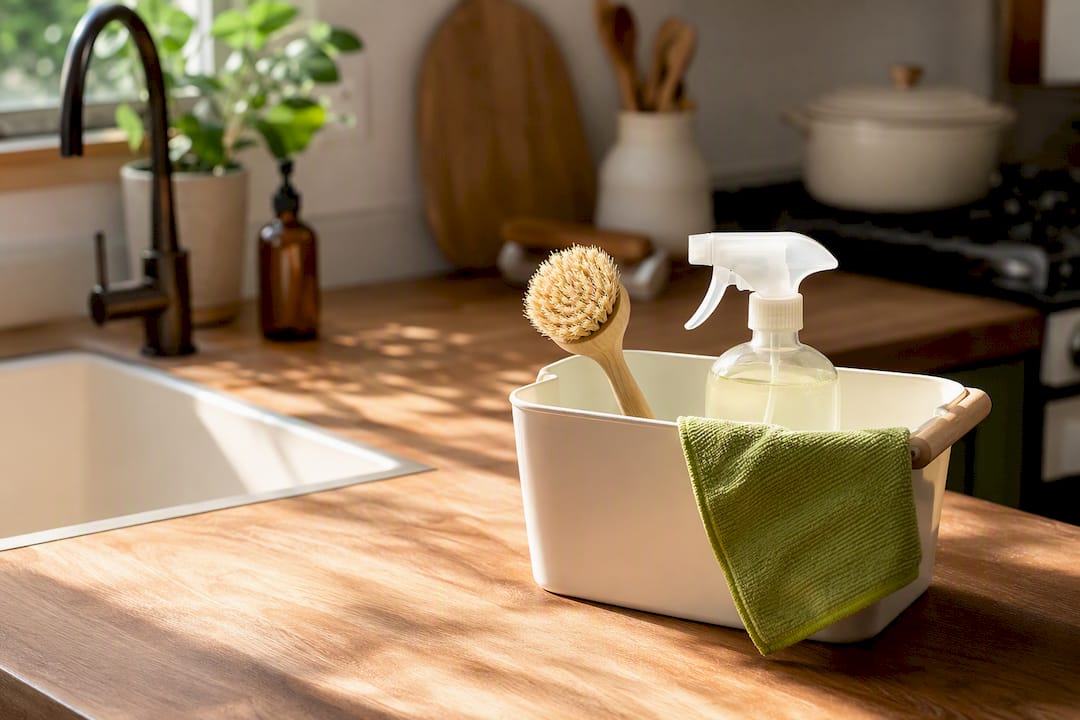
Pro Tip: Do your kitchen reset while something else is happening, like the kettle boiling or the dishwasher finishing its cycle. Stacking the habit onto something you already wait for makes it stick.
What should a weekly cleaning schedule for home look like?
Weekly tasks are where most of your actual scrubbing happens. Bathrooms need a real clean, floors need vacuuming and mopping, bedding needs washing, and dust needs wiping from surfaces that accumulate it fast, television stands, coffee tables, windowsills.
A workable weekly split looks like this:
- Monday: Bathrooms, full scrub, toilets, tubs, sinks, mirrors (20 to 30 minutes)
- Tuesday: Vacuum all floors and rugs (15 to 20 minutes)
- Wednesday: Mop hard floors, kitchen and bathroom especially (15 minutes)
- Thursday: Dust surfaces, shelves, electronics, blinds (15 minutes)
- Friday: Wash and change bedding, wipe kitchen touchpoints, cabinet handles, light switches (20 minutes)
- Weekend: One longer session, 45 to 60 minutes, for whatever got missed plus a general tidy
Splitting weekly work into short weekday blocks tends to beat one marathon weekend clean for most households. Distributing tasks across the week can bring a typical two-bedroom home down to around four hours of total weekly cleaning time, spread thin enough that no single day feels like a chore.
If you have pets or young kids, move vacuuming up to every two to three days instead of once weekly. Shedding fur and tracked-in dirt accumulate far faster than in a pet-free, adult-only household, and letting it sit means more of it grinds into carpet fibres where it’s harder to remove later.
If a weekend session isn’t realistic some weeks, at minimum keep the bathroom scrub and the vacuum pass. Those two tasks prevent the most visible and the most hygiene-relevant buildup. Everything else can wait a few extra days without real consequence.
Which monthly cleaning tasks protect your home’s condition?
Monthly tasks are the ones that don’t look urgent until they are. Nobody notices baseboard dust until it’s a visible grey line. Nobody thinks about vent buildup until allergies flare up. But these are also the tasks that protect your actual investment, in flooring, in appliances, in air quality.
A realistic monthly list includes:
- Wipe down appliance interiors: microwave, oven, fridge shelves
- Clean cabinet and drawer faces, especially near the stove where grease settles
- Dust and wipe baseboards throughout the main living areas
- Check and vacuum air vents and returns
- Deep clean or replace trash can liners and wipe the bins themselves
- Vacuum upholstery and under furniture where dust collects unseen
Carpet care sits partly in this monthly rhythm too. Regular vacuuming between deep cleans is what the Carpet and Rug Institute’s CRI 205 maintenance standard points to as the main defence against fibre wear, since grit ground into carpet backing does more damage than foot traffic alone.
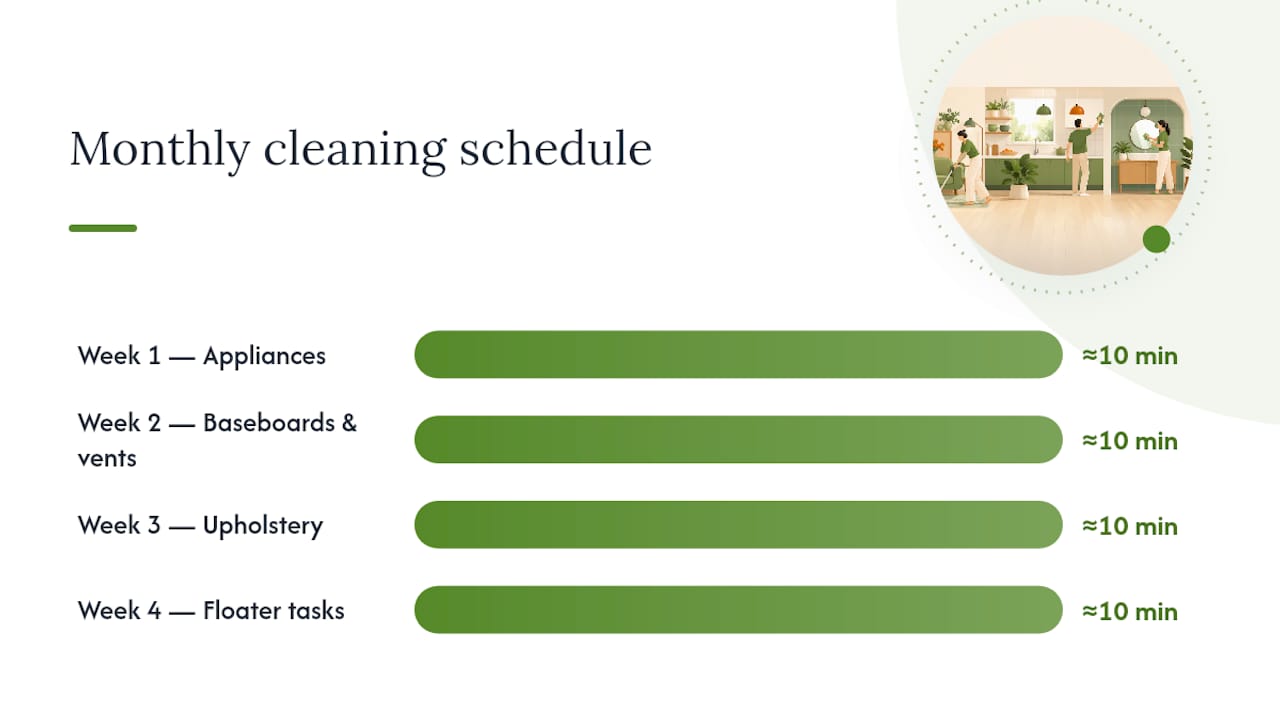
The easiest way to actually get through this list is to assign one monthly task per week rather than trying to do all of it in a single afternoon. Week one is appliances, week two is baseboards and vents, week three is upholstery, week four is a floater for whatever’s been neglected. Spread this way, monthly cleaning barely adds ten extra minutes to your existing weekly routine.
How often should carpets, windows, and HVAC systems get a deep clean?
Some jobs don’t fit a weekly or monthly rhythm. They need real time, sometimes real equipment, and they happen once or twice a year at most. This is where seasonal cleaning earns its name, tied to changing weather, allergy seasons, and the slow buildup that daily and weekly cleaning simply can’t reach.
Typical seasonal tasks:
- Deep clean carpets using hot water extraction, ideally by a professional
- Wash interior and exterior windows
- Clear gutters, especially before spring rain and after fall leaf drop
- Pull out major appliances (fridge, stove) to clean behind and underneath
- Rotate or flip your mattress
- Wash curtains, throw pillows, and other soft furnishings that rarely get touched
Carpet frequency has real guidance behind it. CRI 205 recommends deep cleaning residential carpets roughly every 12 to 24 months, with the shorter end of that range, 12 to 18 months, applying to higher traffic homes with kids, pets, or multiple occupants. HVAC filters need attention far more often: every one to three months depending on filter type and whether you have pets, with a full vent and duct check once a year.
Professional help earns its cost at a few clear trigger points: moving into or out of a home, tackling heavy pet odour that’s worked into carpet padding, managing allergy symptoms that DIY cleaning isn’t fixing, or simply wanting a full reset at the end of a season without losing a weekend to it.
How do you customise a cleaning schedule to fit your home?
No schedule works for everyone as written. The frequencies above are a starting point, and five factors determine how much you should adjust them.
- Household size: More people means more dishes, more laundry, more bathroom use. Add a day to your weekly bathroom rotation for every two extra household members.
- Pets: Shedding and tracked-in dirt roughly double or triple how often floors need attention. If you’re vacuuming weekly without pets, expect two to three times weekly with them.
- Allergies or respiratory health: Households managing asthma or allergies should dust and vacuum more often and use a HEPA-filter vacuum to actually capture particulates instead of just stirring them into the air.
- Lifestyle and foot traffic: Working from home, running a home business, or hosting frequently all push cleaning frequency up, especially in entryways and kitchens.
- Surface and flooring type: Carpet holds allergens and dirt longer than hardwood or tile, so carpeted homes generally need more frequent vacuuming to hit the same cleanliness level.
During a busy stretch, a minimal survival plan still works: keep the nightly kitchen wipe and the weekly bathroom scrub, and let everything else slide for a week or two. Scale back up once things calm down rather than trying to catch up all at once.
If you’re hiring outside help, ask exactly what “biweekly” means in the contract, since it’s sometimes read as every two weeks and sometimes as twice a week, and confirming this upfront avoids a mismatch between what you expect and what shows up. Ask, too, whether you’ll get the same crew each visit. Consistency matters more to cleaning quality than most people assume.
Pro Tip: If a provider can’t clearly define their cleaning cadence in writing, that’s a signal to ask more questions before signing anything.
Special cases: pets, allergies, rentals, and busy households
A few situations call for changes beyond the standard framework.
- Pet households: Vacuum two to three times weekly, clean upholstery monthly instead of seasonally, and scoop or wipe litter areas daily to control odour.
- Allergy and asthma households: Wash bedding weekly in hot water, dust with a damp cloth rather than dry, and use a HEPA-filter vacuum on every pass, not just monthly deep cleans. A partner resource on allergy-safe cleaning methods covers additional product and technique choices worth checking if symptoms persist.
- Renters and move-outs: Book a deep clean, appliances, baseboards, grout, at least a week before your final walkthrough, not the night before, so there’s time to fix anything missed.
- Work-from-home households: Treat your home office like a second kitchen touchpoint zone, wiping desks and shared equipment daily, since foot traffic there is now constant rather than occasional.
Ateliermaids’ perspective: how we set frequency for recurring clients
Biweekly is what most of our recurring clients land on. It’s frequent enough to stop grease and soap scum from hardening, which is the exact problem that makes a monthly clean feel like starting from zero. Larger households, or homes managing pets and allergies, usually move to weekly instead.
What makes any cadence work long term is consistency of execution, not just consistency of scheduling. That’s why every recurring client gets the same dedicated crew visit after visit, working from a flat price with no surprise add ons, and a service report after each clean so nothing quietly gets skipped over months. A guarantee only means something if the standard behind it doesn’t slip, and that’s the piece we’ve built the whole model around.
How Ateliermaids fits into your cleaning routine
Building and sticking to a layered schedule is doable solo, but it competes with everything else on your plate. Ateliermaids exists for the weeks that framework falls apart: recurring house cleaning with the same dedicated crew every visit, a flat price with no surprises, and a written service report after each clean so you know exactly what got done.

Whether you need a one-time seasonal deep clean or a standing biweekly visit, the full range of cleaning services covers both, along with office and commercial options if you’re managing more than just a household. Book a visit and let the schedule run itself from there.
Where this guidance comes from
The daily, weekly, monthly, seasonal framework in this guide draws on Good Housekeeping’s cleaning schedule, which lays out practical task groupings and checklist-style timing. Carpet cadence recommendations come from the Carpet and Rug Institute’s CRI 205 standard, the industry benchmark for residential carpet maintenance. Allergy and asthma adjustments follow guidance from the American Academy of Allergy, Asthma & Immunology. Readers managing ongoing sensitivities may also find the partner guide on allergy-safe cleaning methods worth a closer read.
Sources
- AAAAI — Cleaning tips for allergy and asthma sufferers
- Carpet and Rug Institute (CRI) — CRI 205 residential carpet maintenance guidance
- Good Housekeeping — The ultimate cleaning schedule for your day, week, month and year