
20 to 30 Minutes a Day: Postable Office Kitchen Cleaning Schedule
20 to 30 Minutes a Day: Postable Office Kitchen Cleaning Schedule
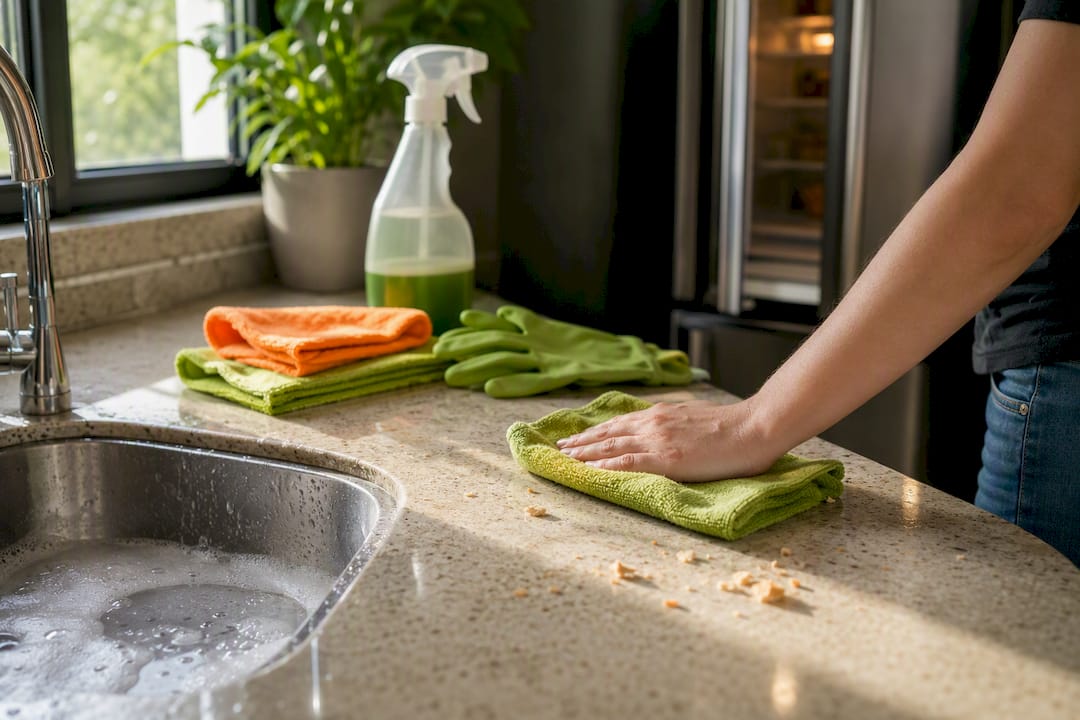
Post a cleaning schedule, wipe down high-touch surfaces every day, reset the fridge weekly, and put one person’s name on the task, whether that’s a rostered staff member, an office manager, or a contracted crew. That combination handles most of what turns a shared kitchen into a health complaint. Canada’s food-safety guidance on perishable storage and a documented routine cover the rest, and the whole thing takes less time than a coffee break.
TL;DR:
- Regular cleaning routines need clear ownership, with specific daily, weekly, and monthly tasks assigned to prevent bacteria buildup and odors.
- Daily tasks focus on wiping high-touch surfaces with proper cleaning and disinfecting sequences, prioritizing handles, switches, and shared equipment.
- Weekly deep-cleaning includes refrigerator interior, microwave, and grout, while monthly tasks target behind appliances and floor areas for long-term hygiene.
- Proper fridge management requires labeling, temperature monitoring, and discarding unlabelled or expired items within two hours of preparation, especially at room temperatures above 32°C.
- A dedicated cleaning crew and simple, posted rules outperform rotating staff or complex policies, ensuring consistent cleanliness and reducing long-term hygiene risks.
Table of Contents
- What is office kitchen cleaning, and why does it need a system?
- What should a copy-ready office kitchen cleaning schedule include?
- What daily tasks keep the kitchen sanitary?
- What weekly and monthly deep-clean tasks does the kitchen need?
- How does the two-hour rule protect a shared fridge?
- Who should own the kitchen, and what rules keep it clean?
- What supplies keep an office kitchen cleaning routine running?
- When does it make sense to hire a professional cleaning service?
- Why do dedicated crews and simple schedules win long term?
- How can Atelier Maids take office kitchen cleaning off your plate?
- Where can you find more on office kitchen hygiene rules?
- Sources
What is office kitchen cleaning, and why does it need a system?
Office kitchen cleaning means keeping a shared food-prep and eating space sanitary through a mix of daily wipe downs, scheduled deep cleans, and clear food-handling rules, not just an occasional tidy-up when someone complains. Most break rooms fail not because nobody cleans, but because nobody owns it. A sponge gets used for three weeks, the fridge fills with unlabelled containers, and the microwave door gets sticky enough that people stop opening it fully. Daily attention to high-touch surfaces, combined with weekly appliance care and monthly deep cleans, is what actually prevents bacterial buildup and long-term odour problems in break rooms. The fix isn’t more effort. It’s a system that assigns the effort to someone, on a schedule, with a checklist that doesn’t rely on memory.
What should a copy-ready office kitchen cleaning schedule include?
Print this, post it above the sink, and assign initials to each line.
- Daily wipe down (5 minutes, staff or admin): counters, table surfaces, microwave exterior, coffee station.
- Daily dish check (2 minutes, staff): no dishes left in the sink overnight.
- Weekly fridge reset (15 minutes, admin or rostered staff): toss expired items, wipe shelves, check temperature.
- Weekly appliance interior clean (10 minutes): microwave interior, coffee machine carafe, dish rack.
- Monthly deep clean (30 to 45 minutes, contracted cleaner or admin): behind appliances, floor grout, drains, filters.
A typical breakroom needs about 20 to 30 minutes of daily upkeep total, split across the day rather than done in one block. For the fridge reset, post a simple line: “Fridge cleared every Friday at 3 PM. Anything without a name and date gets tossed.”
What daily tasks keep the kitchen sanitary?
Daily cleaning is about the surfaces everyone touches without thinking: fridge and microwave door handles, the coffee machine buttons, faucet handles, light switches, and the shared table. These accumulate more bacteria than almost anything else in the room simply because of how often hands land on them.
The order matters here. Clean first to remove visible grime and food residue, then disinfect, since disinfectants only work properly on a surface that’s already been physically cleaned. Skipping the first step and going straight to a spray wipe leaves grease and crumbs trapping bacteria underneath.
- Wipe counters and the table with an all-purpose cleaner, then follow with disinfectant, letting it sit for the dwell time listed on the label (often one to five minutes).
- Clean the microwave door handle and buttons daily. This gets touched more than almost anything else in the room.
- Disinfect the coffee machine’s exterior buttons and drip tray daily. Rinse the carafe after each use.
- Wipe faucet handles and light switches once a day, ideally at the end of the shift.
Pro Tip: In offices with staggered shifts, assign the wipe down to whoever’s leaving at the end of their block rather than whoever arrives first. People clean up after themselves far more reliably than they clean up before someone else uses the space.
What weekly and monthly deep-clean tasks does the kitchen need?
Daily wiping handles surface bacteria, but grease, mould, and mineral buildup need a longer cycle. Weekly and monthly cleaning, alongside the daily routine, is what actually stops long-term odour and bacterial problems from taking hold.
Weekly (15 to 25 minutes, staff or admin):
- Empty and wipe the fridge interior, including door seals where mould collects.
- Deep clean the microwave interior with a steam trick: heat a bowl of water and vinegar for two minutes, then wipe away loosened grime.
- Disinfect the dish rack and drying mat.
Monthly (30 to 45 minutes, admin or contracted cleaner):
- Move the microwave and toaster to clean underneath and behind them.
- Scrub floor grout and any tile seams near the sink.
- Descale the coffee machine and check the fridge door seal for wear.
Book a deep clean outside this cycle whenever there’s a persistent odour, a pest sighting, or right after a large office event.
How does the two-hour rule protect a shared fridge?
Perishable food needs to go into the fridge within two hours of preparation or purchase, and that window shrinks to just one hour if the room temperature climbs above 32°C, according to Canada’s food-safety guidance. A lunch left on a desk through a long afternoon meeting is exactly the kind of thing this rule exists for.
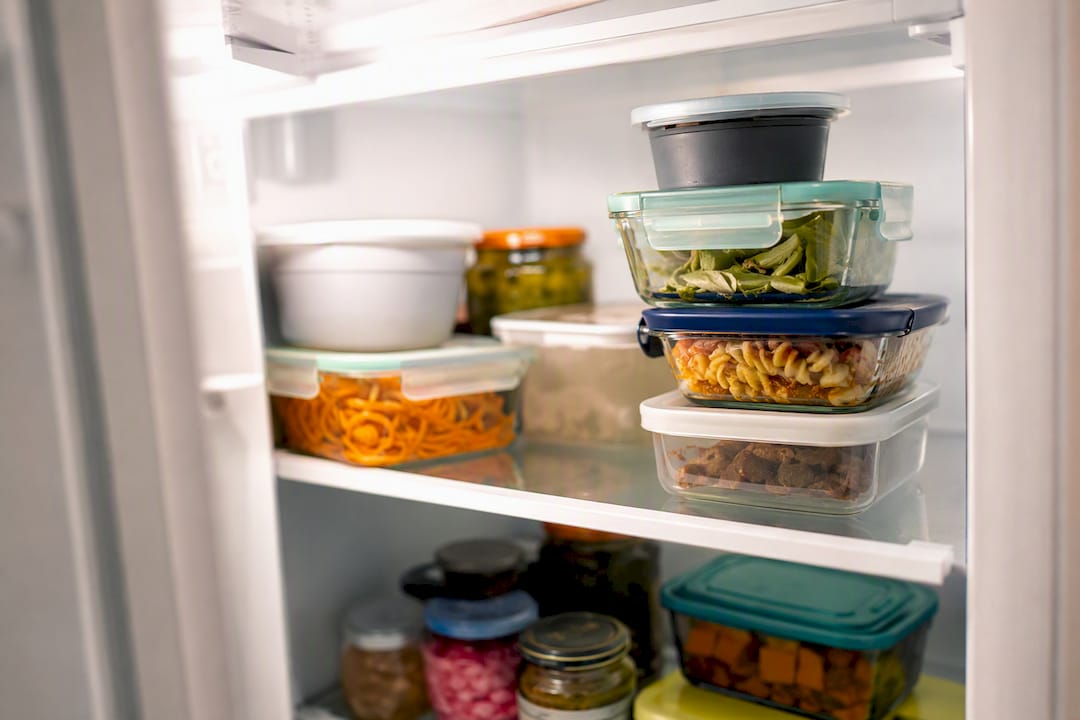
The fridge itself needs to stay at 4°C (40°F) or below. An inexpensive appliance thermometer left on a middle shelf is the only reliable way to confirm that, since a fridge’s built-in dial often lies by a few degrees.
Beyond temperature, three habits keep the fridge from becoming a hazard: label everything with a name and date, store raw meat and fish on the bottom shelf so they can’t drip onto ready-to-eat food, and run a weekly purge where anything unlabelled or expired gets thrown out without exception.
Who should own the kitchen, and what rules keep it clean?
A kitchen without a named owner drifts back to chaos within a week, no matter how good the schedule looks on paper. Short, posted rules work better than long policies nobody reads:
- “Label your food with your name and date, or it gets tossed on Friday.”
- “Rinse your dishes. Don’t leave them in the sink.”
- “Wipe the microwave after you use it.”
Post these at eye level near the fridge and above the sink, not buried in an email nobody reopens.
Three ownership models tend to work: a rotating staff roster (cheap, but consistency drops when someone’s on vacation), an admin-managed system (more consistent, but adds to one person’s workload), and a contracted cleaning service (the most consistent, at a monthly cost). For repeated non-compliance, a quiet one-on-one from the office manager works better than a group email, which usually just annoys the people already following the rules.
What supplies keep an office kitchen cleaning routine running?
A stocked supply cabinet is what separates a kitchen that gets cleaned from one where good intentions stall out because nobody can find a rag.
- All-purpose cleaner and a food-safe sanitizer for countertops and tables.
- An EPA-registered disinfectant for high-touch points like handles and switches.
- Disposable paper towels or a rotation of launderable microfibre cloths.
- Colour-coded microfibre cloths, since using separate cloths for dishes versus counters avoids cross-contamination.
- An appliance thermometer, scrub pads, and enough trash liners to avoid a Friday scramble.
Restock monthly, and keep everything in one labelled cabinet near the sink rather than scattered across drawers.
When does it make sense to hire a professional cleaning service?
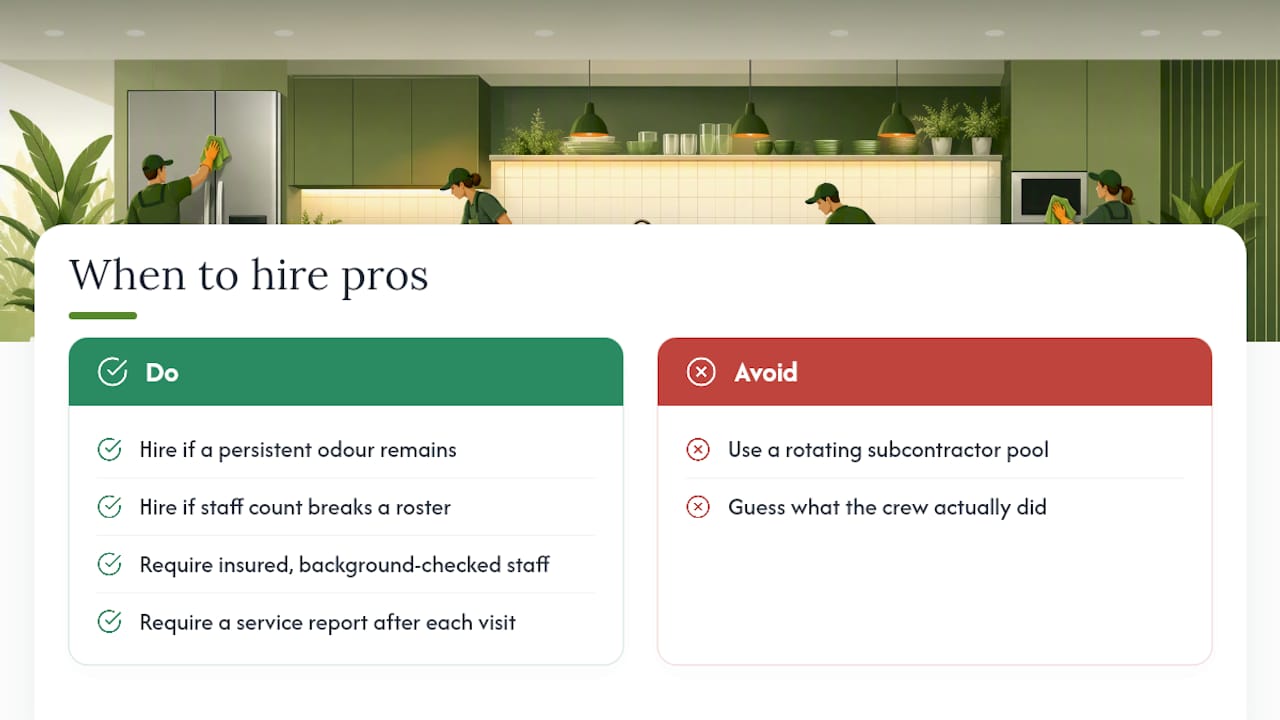
A posted schedule and an assigned owner solve most small offices’ problems. Hire a professional once you notice a persistent odour that doesn’t clear after a deep clean, a staff count that makes a rotating roster unworkable, high turnover that keeps resetting whoever “owns” the kitchen, or appliances that need maintenance nobody in the office is equipped to do.
If you’re comparing proposals, ask for four things in writing: insured and background-checked staff, food-safe cleaning procedures for kitchen surfaces, a fixed schedule with clear task frequency, and a service report after every visit so you’re not guessing what actually got done. A dedicated crew that returns to the same space repeatedly, rather than a rotating pool of subcontractors, tends to catch problems (a slow fridge leak, a build-up behind the toaster) that a one-off crew would miss entirely.
Why do dedicated crews and simple schedules win long term?
A rotating cast of cleaners means a different person interprets “clean the kitchen” every visit, and standards drift within weeks. A dedicated crew that returns to the same office learns where the coffee stains hide and which fridge shelf always needs attention first, and that familiarity closes gaps a generic checklist can’t.
That’s the same logic behind Atelier Maids’ model: one crew per client, a flat price with no surprise invoices, and a service report after every visit so the office manager knows exactly what got done. Whatever route your office takes, the audit is simple. Walk in Monday morning and check three things: is there a posted schedule, is the fridge purge date current, and does someone’s name sit next to each task?
— Atelier
How can Atelier Maids take office kitchen cleaning off your plate?
If a rotating staff roster keeps falling apart because people are busy, or the admin managing it is stretched too thin already, a contracted service closes that gap without anyone having to nag their coworkers about dirty mugs.
Atelier Maids runs office cleaning across the Greater Toronto Area with a dedicated crew assigned to your space, not a rotating pool of subcontractors who relearn your kitchen every visit. Pricing is flat, so there’s no surprise invoice after a deep clean, and every visit ends with a service report showing exactly what got wiped, disinfected, and restocked. Teams are insured and background-checked, and the work is backed by a satisfaction guarantee. If your break room needs a reliable fix rather than another posted sign nobody follows, get a quote through the office cleaning page and see what a fixed schedule with a dedicated crew looks like for your space.
Where can you find more on office kitchen hygiene rules?
For the exact food-safety timing behind fridge and storage rules, see Canada’s guidance on safe food handling at home. For a downloadable task list with frequency guidance, check the break room cleaning checklist from POPProbe.
Sources
- Canada
- Breakroom cleaning: the office area most companies neglect - E&R Cleaning Services
- Office break room cleaning: a complete guide - Jani-King